Magic Words - Toddler Bulletin Board: A Designer's Guide
More Than Just a Display: Understanding the Magic
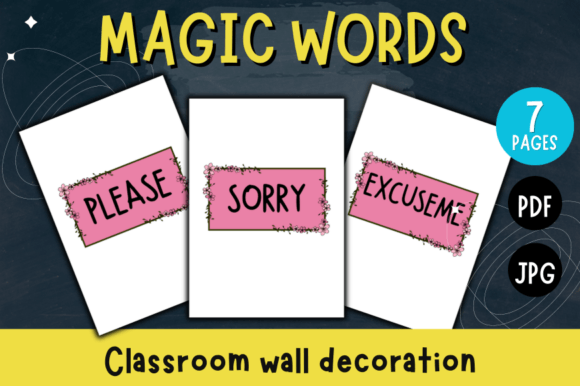
When you first encounter the Magic Words - Toddler Bulletin Board, it’s easy to see it as a simple classroom decoration. But for those of us working in design, branding, or content creation, it’s a masterclass in early-stage visual communication. This isn't just a collection of colorful letters; it's a carefully constructed tool designed to shape a child's first interactions with language. The core idea is to make foundational words—like "please," "thank you," "share," and "help"—feel approachable and exciting. Each word is presented as a distinct, playful element, often paired with a simple, intuitive illustration that reinforces its meaning without relying on text. This approach taps into a fundamental design principle: show, don't just tell.
The visual personality of the Magic Words - Toddler Bulletin Board is intentionally warm, friendly, and non-intimidating. It avoids sharp edges and complex patterns in favor of soft shapes, primary and secondary colors, and a sense of whimsy. The illustrations are character-driven, giving each word a tiny mascot or visual cue. This isn't about creating a sophisticated typographic hierarchy for adults; it's about creating a visual hierarchy for developing minds. The "font" used is less about stylistic flair and more about absolute clarity and recognition. Each letterform is consistent, sturdy, and designed to be easily identified by a toddler who is just learning to distinguish between a 'B' and a 'D'. For a designer, observing this is a reminder that the most effective typeface is always the one that serves its audience perfectly.
From Classroom Walls to Brand Strategy: Unexpected Applications
While its primary home is an early childhood setting, the principles and even the assets of the Magic Words - Toddler Bulletin Board have surprising utility in broader creative projects. Think about brands targeting parents, educators, or the family market. The visual language of this board—its approachability, clarity, and positive reinforcement—is a goldmine. A children's book author could use the playful illustrations as inspiration for character design. A marketer for an educational app might study how the board simplifies complex social concepts into single, digestible words and images. The included PDF and JPEG files offer direct assets. A blogger could use the word graphics as social media stickers or in newsletter headers to add a touch of playful warmth. A small business owner creating party supplies or nursery decor could adapt the color palette and illustrative style for their own packaging and web design, ensuring their brand identity feels just as welcoming.
The real value lies in its function as a case study in visual hierarchy and audience engagement. The board doesn't just list words; it creates a system. This is directly applicable to designing a logo for a family-centric brand, where the mark needs to be simple, memorable, and full of personality. It informs editorial design for parenting magazines, where layouts need to guide the eye effortlessly. The key takeaway is how it uses color and illustration to create consistency and brand perception. The consistent style across all seven pages builds a recognizable world. For your own projects, this translates to building a cohesive brand identity where every element, from the font pairing on your website to the illustrations in your packaging design, speaks the same friendly, clear language.
A Practical Toolkit: Leveraging the Asset
For the practical creator, the Magic Words - Toddler Bulletin Board is a ready-made design asset. The download includes both PDF and JPEG files, giving you flexibility. The JPEGs are perfect for quick integration into digital projects—think adding a "Please" or "Thank You" graphic to an Instagram story about customer service or a "Share" button visual on a blog post. The PDFs ensure high-quality reproduction if you decide to incorporate the designs into printed materials like thank-you cards or classroom handouts for clients in the education sector.
However, it's crucial to understand its context. This is not a premium font family like a sophisticated serif font for long-form reading or a clean sans serif font for a corporate website. It is a display font in its purest form—a handwritten font style meant for short, impactful bursts of text. Its strength is in its specificity. You wouldn't use it for body copy on a law firm's website, but you might use its aesthetic to inspire the playful script in a bakery's logo or the friendly lettering on a child's birthday invitation. When evaluating it for a project, ask: Does my audience need to feel welcomed and encouraged? Is my project about learning, kindness, or family? If yes, then the visual style of the Magic Words board is a relevant reference point.
Finally, always respect the terms of use. The license is for personal use, meaning you can use it for your own home, classroom, or personal creative projects. You cannot sell the files themselves or distribute them. This is a standard and important boundary for commercial font and asset licensing. The most professional approach is to use it as a springboard for your own original creations or to use the provided files in strictly personal, non-commercial applications. By doing so, you honor the creator's work while still drawing immense inspiration from its thoughtful, magical design for the youngest among us.