Sticky Note Counting Houses: Tailored Math Worksheets for Autism
Transforming Numeracy Through Sensory-Friendly Design
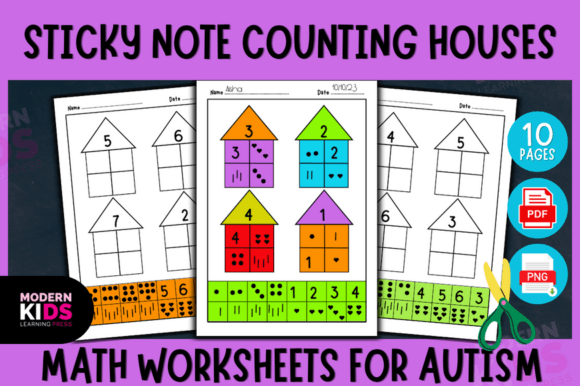
When we approach educational materials for neurodiverse learners, standard cookie-cutter worksheets often fall short. "Counting Houses - Worksheets for Autism" represents a shift in how we design for inclusivity and engagement. This resource is not just a collection of printables; it is a carefully curated set of activities intended to bridge the gap between abstract numbers and tangible understanding. The core concept revolves around "Sticky Note Counting Houses," a method that utilizes the familiar, tactile nature of sticky notes to anchor mathematical concepts. For educators, therapists, and parents, this offers a practical solution to a common challenge: maintaining focus while teaching foundational math skills.
The visual design of these worksheets prioritizes clarity over clutter. In modern typography and educational design, whitespace is not wasted space—it is a functional tool for cognitive processing. These sheets utilize a minimalist aesthetic, ensuring that the learner’s attention is directed solely toward the task at hand. The layout mimics the structure of a house, providing a visual container that helps students with autism understand boundaries and organization. This is a crucial design element; by defining a specific "home" for each number or sticky note, we reduce visual noise and anxiety, creating a calm environment for learning. The graphics are high-contrast yet gentle, avoiding the overstimulating colors and chaotic patterns often found in mass-market educational products.
The Mechanics of Engagement: Why the "House" Concept Works
From a design perspective, the "Counting Houses" concept leverages the psychology of spatial organization. For many individuals on the autism spectrum, visual structure is a gateway to comprehension. The worksheets provide a skeletal framework—a house outline—that serves as a guide. The user interaction is tactile; by using sticky notes, the activity transforms from a passive writing exercise into an active, hands-on experience. This physical engagement is vital for kinesthetic learners and helps bridge the gap between fine motor skills and cognitive processing.
The file package, which includes high-resolution PDFs and PNGs at 300 DPI, speaks to the versatility required by modern creators and educators. The inclusion of PNG files specifically suggests compatibility with digital cutting machines, allowing for precision crafting. Whether you are a parent creating a custom homeschool curriculum or a small business owner designing a specialized learning center, the assets provided are print-ready and scalable. The visual style is professional enough for commercial educational settings—such as therapy centers or specialized schools—yet warm and inviting enough for a kitchen table at home. This duality is the hallmark of effective brand identity in the educational sector: serious about learning, but approachable in execution.
Strategic Application in Educational Environments
Implementing these worksheets requires more than just hitting "print." To maximize their effectiveness, consider the environment in which they will be used. The design is inherently flexible, allowing for adaptation based on the learner's current skill level.
- Visual Hierarchy and Focus: The layout naturally creates a visual hierarchy. The house acts as the primary focal point, while the numbers serve as secondary anchors. This prevents the "sea of text" effect that can overwhelm learners with sensory sensitivities.
- Customization via Print then Cut: For those using cutting machines, the ability to "Print then Cut" allows for customization of materials. You can print the house outlines on different textures of paper or cardstock, further enhancing the sensory experience.
- Incremental Learning: The 10-page structure allows for a scaffolded approach. You can introduce one "house" at a time, ensuring mastery before moving to the next concept.
For designers and content creators working in the ed-tech or educational resource space, "Counting Houses" offers a case study in user-centered design. It moves away from generic stock imagery and toward functional, purpose-driven graphics. The aesthetic is clean and modern, aligning with current trends in web design and editorial design where minimalism drives clarity.
Beyond the Classroom: Branding and Consistency
While the primary application is educational, the underlying design principles have broader implications for branding. If you are a tutor or run a specialized learning center, using resources like these helps establish a consistent brand identity. Consistency in educational materials builds trust with parents and caregivers. When your worksheets look professional, organized, and thoughtfully designed, it reflects the quality of instruction.
Imagine integrating these worksheets into a larger suite of educational tools. The clean lines and structured layout make them easy to pair with other design assets. You could create matching flashcards, progress charts, or digital presentations that share the same visual DNA. This creates a cohesive ecosystem for the learner, where every piece of material feels familiar and safe. In the realm of packaging design for educational kits, the "house" motif could easily extend to box art or folder organization, creating a seamless unboxing experience for the end-user.
Practical Implementation and Technical Considerations
To get the most out of this resource, a strategic approach to printing and preparation is necessary. The files are provided at 8.5x11 inches, the standard letter size, ensuring compatibility with almost any home or office printer. However, the quality of the output depends on the materials used.
- Paper Selection: For the base worksheets, a heavier cardstock (65lb or higher) is recommended. This prevents curling and provides a sturdy surface for the sticky notes.
- Sticky Note Preparation: The design relies on the interaction between the printed page and the sticky note. Ensure that the sticky notes you purchase are the standard 3x3 inch size to fit the designated "houses" on the page.
- Digital Integration: If you are using a tablet for instruction, the PNG files can be imported into apps like GoodNotes or Notability. This allows for a paperless workflow where students can drag and drop digital stickers, maintaining the "counting house" logic in a digital format.
The versatility of the PNG format cannot be overstated. Unlike a flattened PDF, the PNG preserves the transparency and crispness of the graphics, making it ideal for layering in design software like Canva or Adobe Illustrator. This is particularly useful for marketers or bloggers creating content about special education; you can easily overlay these graphics onto blog headers or social media posts to illustrate concepts visually.
Final Thoughts on Inclusive Design
Ultimately, "Counting Houses - Worksheets for Autism" is more than a download; it is a tool for empowerment. It acknowledges that learning math is not just about numbers—it is about how those numbers are presented. By removing visual barriers and introducing tactile engagement, these worksheets provide a pathway to success for learners who might otherwise struggle with traditional methods.
For the creative professional, this resource highlights the importance of empathy in design. It proves that functional design does not have to be boring. It can be colorful, engaging, and highly structured all at once. Whether you are a parent looking for a quiet afternoon activity, a teacher preparing a classroom, or a designer seeking inspiration for inclusive projects, the principles found in these counting houses are universally applicable. They remind us that good design is, at its core, about making life easier and more accessible for everyone.